By: David Bibo
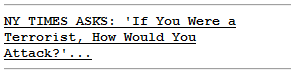
Self-described “rogue economist” Steven D. Levitt’s latest blog entry is likely to become a story itself, having earned a headline on the Drudge Report today. Levitt, co-author of the bestseller Freakonomics, wonders “what I would do to maximize terror if I were a terrorist with limited resources.”
After sharing his own thoughts on the subject, Levitt invites his readers to share theirs. Less than 12 hours after his post, about 90% of the commenters (400+) have offered up suggestions. The remainder have suggested this exercise may do more harm than good, a sentiment I find myself agreeing with.

Tags: Economics, Freakonomics, Levitt, New York Times, Terrorism
Related Posts:
Comments 2
For the sake of discussion, I’ll take a contrary position.
Bottom line up front - I don’t believe that this exercise will do more harm than good. I, for one, think public debate in a democratic society is a good thing. Something which, might I add, we have had precious little of, up to this point in the War on Terror. I’m also not concerned that “terrorists” will gain any special “idea” advantages from Levitt’s blog. Certainly not when there is tremendous competition in this area coming from popular culture, TV, film, news broadcasts, online networking, etc. For example, one episode of “24″ could give an individual more ideas than he/she could possibly put into action.
Ironically, Samantha Power has recently written a book review for the NYT and addressed this very topic. One of the books she recommends is by Stephen Flynn, senior fellow at the Council on Foreign Relations, titled: THE EDGE OF DISASTER: Rebuilding a Resilient Nation. In her review, she writes:
I think this is as good a time as any to reflect back on what makes the United States a truly great nation, and it’s not our powerful military or our tremendous economic capacity. The concepts that set America apart are our aspirations for liberty, freedom, and opportunity for all, as well as transparency and legitimacy in governance.
Speaking freely and talking openly - even if it is scary to some - plays to directly to our strengths, therefore I think we should do more of it, not less.
Posted 09 Aug 2025 at 12:49 am ¶I agree.
Besides, terrorists aren’t rational economists. They are motivated by faith. They want high profile, glory-filled targets, not maximally efficient ones.
See http://collectedvoices.blogspot.com/2007/08/are-they-terrorists-response-to-steven.html
Posted 10 Aug 2025 at 4:06 pm ¶Post a Comment